
For most of its 100-year history, Caterpillar (NYSE: CAT) was the ultimate cyclical bellwether — a proxy for construction spending, commodity prices, and the health of the global industrial economy. Buy it when mines and job sites are humming, sell it when the cycle turns. That mental model is now being torn up. In 2026, the single most important driver of Caterpillar’s stock is something that would have sounded absurd a few years ago: artificial intelligence data centers. The gigawatts of power those facilities consume have to come from somewhere, and increasingly that “somewhere” is a Caterpillar reciprocating engine or gas turbine humming behind a hyperscale campus.
This Caterpillar AI data center power backlog analysis exists because of one number that reframes the entire investment case. In its first-quarter 2026 report, Caterpillar disclosed an order backlog of roughly $63 billion — up an extraordinary 79% year over year. That is not a sentiment survey or a management aspiration; it is committed, contracted future demand sitting on the books. When a company with $70 billion in trailing revenue is carrying a backlog nearly equal to a full year of sales, the conversation shifts from “where are we in the cycle?” to “how fast can they build it?”
Here are the three investment points this article will develop. First, the AI power re-rating is real but concentrated — the Power & Energy segment, not the yellow excavators most people picture, is doing the heavy lifting, with data-center power generation demand up 48% in the latest quarter. Second, the earnings power is inflecting — Q1 2026 adjusted EPS of $5.54 came in nearly 20% above Wall Street’s $4.62 estimate and grew 30% year over year, prompting management to raise full-year guidance. Third, valuation is the entire debate — at $940 per share, roughly 47 times trailing earnings and just above the average analyst target of $987, the market has already priced in a great deal of good news, which changes the risk-reward materially versus a year ago.
Over the following sections we will map Caterpillar’s business model and segment mix, dissect the industrial and AI-power industry backdrop that is the deepest part of this analysis, evaluate the durability of its economic moat, work through the financials and the tariff headwind squeezing certain margins, run a valuation with explicit bull/base/bear scenarios, catalog the key risks, and finish with a concrete rating and exit plan. The goal is not to cheerlead a stock that has already tripled off its lows — it is to figure out what you should actually pay for it today.
1. Company Overview
Caterpillar is the world’s largest manufacturer of construction and mining equipment, diesel and natural gas engines, industrial gas turbines, and diesel-electric locomotives. Founded in 1925, it sells through an extensive independent dealer network that spans virtually every country — a distribution moat we will return to. The company generated $70.75 billion in trailing-twelve-month sales and carries a market capitalization of about $433 billion, making it one of the largest industrials on the planet.
Crucially, Caterpillar does not make money the way casual observers assume. It is no longer primarily a “dig and build” company. As of 2025 the business is organized into three primary Machinery, Energy & Transportation segments — Construction Industries, Resource Industries, and Power & Energy — plus a Financial Products segment that finances customer equipment purchases. That last piece matters: the captive finance arm both smooths sales and generates a steady, higher-margin revenue stream, giving Caterpillar characteristics closer to a capital-goods-plus-finance hybrid than a pure equipment maker.
The segment mix, using the most recent quarter (Q1 2026) as the clearest lens, looks like this:
Segment Q1 2026 Sales YoY Change Segment Profit Profit Margin What it does Construction Industries $7.2B +38% $1.54B (+50%) 21.4% Excavators, dozers, backhoes, compact equipment for infrastructure and building Power & Energy $7.0B +22% $1.45B (+13%) 20.6% Reciprocating engines, gas turbines, gensets for data centers, oil & gas, power Resource Industries $3.8B +4% $378M (-39%) 10.0% Large mining trucks, surface & underground mining equipment Financial Products ~$1.1B — — — Retail & wholesale financing of Caterpillar equipment
Consolidated Q1 2026 revenue was $17.4 billion after intersegment eliminations.
Two things jump out. First, Construction Industries and Power & Energy are the twin engines — together roughly $14.2 billion of the quarter’s sales, both growing double digits, both with margins above 20%. Second, Resource Industries is the laggard, with margins compressed to 10% (more on the tariff cause below) even though its order intake was the strongest since 2012.
On market position, Caterpillar is the clear global leader in heavy construction and mining equipment, competing with Japan’s Komatsu, Sweden’s Volvo Construction Equipment, and Sweden’s Sandvik and Epiroc in mining, and with Cummins in engines. In the fast-growing data-center power niche, its large reciprocating-engine gensets and turbines (including the Solar Turbines and G3500 gas-engine lines) put it head-to-head with Cummins and GE Vernova. Institutional ownership is high — the shareholder base is dominated by index funds and large asset managers such as Vanguard, BlackRock, and State Street — while insider ownership is modest, typical of a century-old blue chip. The dividend is a core part of the story: Caterpillar is a Dividend Aristocrat, having raised its payout for over three decades, which anchors a portion of the shareholder base regardless of the AI narrative.
2. Industry Analysis
This is the most important section of the analysis, because Caterpillar’s re-rating is fundamentally a bet on the industries it serves rather than on the company reinventing itself. Three distinct end markets — data-center power, global construction/infrastructure, and mining — are converging in Caterpillar’s favor, and understanding their size, growth, and structure is the key to sizing the opportunity.
2-1. Market Size & Growth Trajectory
The headline driver is electricity demand from AI data centers. After nearly two decades of flat U.S. power consumption, the grid is entering a demand supercycle. Hyperscale operators are racing to bring compute online faster than utilities can build baseload generation, and the gap is being filled by on-site and behind-the-meter power — exactly the reciprocating engines and gas turbines Caterpillar builds. The global market for large power-generation equipment tied to data centers has moved from a niche to a structural growth market effectively overnight; within Caterpillar, sales to users in power generation rose 48% in Q1 2026, driven specifically by large data-center applications. Management’s own commentary frames data-center power as a multi-year demand pull rather than a one-quarter spike, which is why the backlog stretches out to 2028 and beyond.
The second market, construction and infrastructure, is a mature but re-accelerating cycle. In the U.S., a combination of reshoring-driven factory construction, federal infrastructure spending, and — increasingly — the physical build-out of data-center campuses themselves (concrete, earthmoving, site prep) is lifting demand for Construction Industries equipment. This is a large-numbers market measured in the hundreds of billions of dollars annually across Caterpillar’s addressable categories, growing in the mid-single digits but with pockets of much faster growth tied to AI infrastructure and energy-transition projects.
The third market, mining, sits at a different point in its cycle — early in a potential upturn. The energy transition requires vast quantities of copper, lithium, and other metals, and after years of under-investment, miners are being forced to expand capacity. Caterpillar’s Resource Industries order intake hitting its highest level since 2012 is the tell: the mining upcycle may be in its early innings even though current segment profitability is depressed by cost headwinds.
2-2. Structural Growth Drivers
Driver 1 — AI power demand as a decade-long tailwind. The most powerful driver is the mismatch between AI compute growth and grid capacity. Training and inference for large models require enormous, always-on power, and utilities cannot build transmission and baseload fast enough. This forces hyperscalers toward distributed generation — natural-gas gensets and turbines sited next to the data center. The flagship example is the Nscale–Microsoft collaboration announced with NVIDIA and Caterpillar for a West Virginia AI factory campus, where Caterpillar G3500 natural-gas generator sets are to be deployed at scale to reach roughly 2 gigawatts of power generation by the first half of 2028. This is not a one-off; it is a template. Every gigawatt of AI compute that can’t wait years for a grid interconnection is a potential Caterpillar order, and this dynamic has a runway measured in years, not quarters.
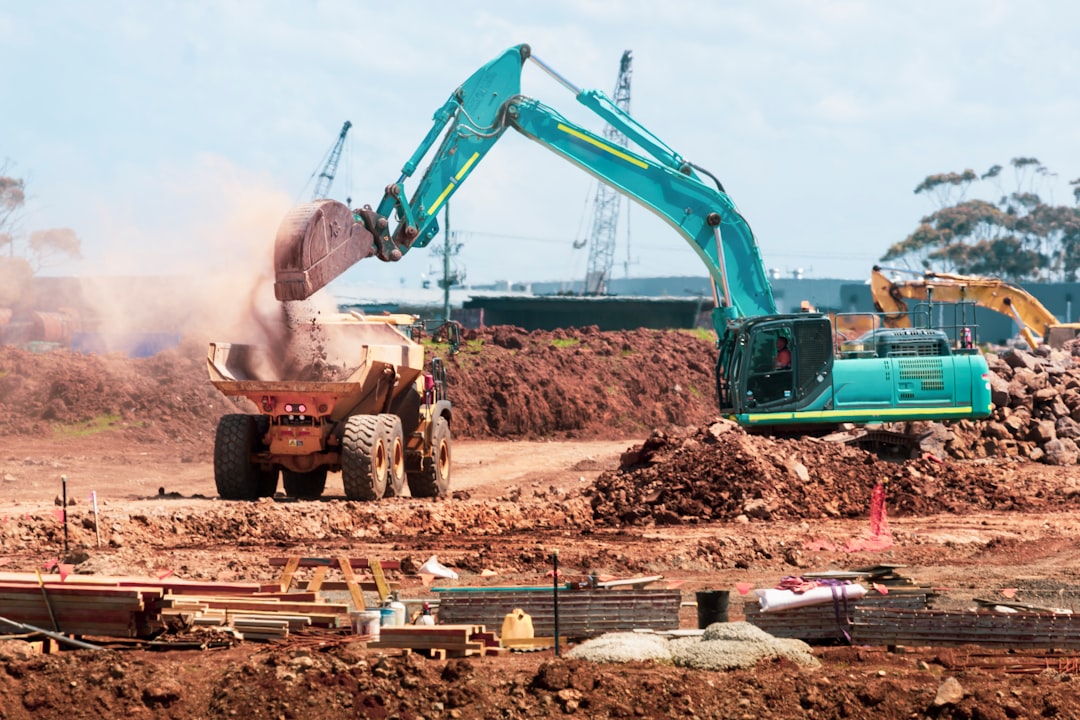
Driver 2 — reshoring, infrastructure, and the physical build-out of AI. Beyond powering data centers, Caterpillar sells the machines that build them and the factories around them. The reshoring of manufacturing to North America, continued government infrastructure funding, and the sheer scale of new industrial construction all feed Construction Industries. Importantly, the AI theme touches this segment too — a data-center campus is a massive earthmoving and site-development project before a single server rack is installed. This gives Caterpillar two bites at the AI apple: the excavators and dozers that prepare the site, and the gensets that power it. The result is a broadening of demand across the equipment portfolio rather than reliance on a single hot product.
Driver 3 — the mining capex upcycle and the energy transition. The long-term electrification of transport and the grid is metals-intensive. Copper demand alone is projected to rise sharply as EVs, renewables, and grid upgrades scale. After a decade of capital discipline, miners are beginning to reinvest, and Resource Industries’ record order intake since 2012 signals the early stage of a replacement-and-expansion cycle. Unlike the AI-power driver, which is playing out now in revenue, this is more of a stored-up tailwind that should convert to profit as tariff headwinds normalize and volume scales. It also diversifies Caterpillar’s growth away from a single theme — a healthy counterbalance if the AI-power narrative cools.
2-3. Competitive Landscape
Caterpillar competes across three fronts, and its position differs by market. The table below frames the key rivals:
Company Primary battleground Approx. scale Relative position vs. CAT Komatsu Construction & mining equipment ~$28B revenue Strong #2 globally; weaker dealer density in Americas Cummins Engines, power generation ~$34B revenue Direct rival in data-center gensets; strong but narrower GE Vernova Gas turbines, grid power ~$36B revenue Competes in large-turbine power; less in distributed gensets Deere & Co. Agriculture (adjacent) ~$45B revenue Different end market; comparison for margins/quality Sandvik / Epiroc Mining equipment ~$12–13B each Focused mining specialists; narrower than CAT
Caterpillar’s advantage over each is breadth plus distribution. No competitor matches the combination of a full-line construction, mining, and power-generation portfolio and one of the industry’s most extensive independent dealer networks. Komatsu is a formidable equipment rival but lacks Caterpillar’s power-generation and finance arms. Cummins is a genuine threat in data-center gensets and arguably competes hardest on the exact AI-power opportunity, but it does not carry Caterpillar’s construction and mining franchises. GE Vernova plays in large turbines but not the distributed reciprocating-engine niche where much of the fast data-center demand sits. The upshot: Caterpillar is one of very few players positioned to monetize both the machines that build AI infrastructure and the engines that power it, which is a large part of why the market is willing to re-rate it.
3. Economic Moat Analysis
Caterpillar’s premium valuation ultimately rests on the durability of its competitive advantages. Two moats stand out, and a third — the finance arm — reinforces them.
Moat Type 1: Distribution and switching costs (the dealer network)
Caterpillar’s most under-appreciated asset is its global network of independent dealers. Building, mining, and power-generation equipment is only as valuable as the uptime it delivers, and uptime depends on parts availability and service. A mine or a data center losing power because a genset is down for want of a part is catastrophically expensive. Caterpillar’s dealer density means parts and trained technicians are rarely far away, which creates powerful switching costs: once a fleet operator standardizes on Caterpillar, the cost and risk of retraining crews, re-tooling maintenance, and re-sourcing parts for a competitor’s fleet is high. This shows up in pricing power — Caterpillar has consistently pushed price to offset cost inflation without losing share, and in the trailing period it maintained a gross margin near 32% and an operating margin above 17% despite significant tariff pressure. Aftermarket parts and services, sold through this network, provide a recurring, higher-margin revenue stream that smooths the equipment cycle. Replicating a century-old dealer network is effectively impossible for a new entrant, which is the essence of a durable moat.
Moat Type 2: Scale, brand, and installed base
Caterpillar’s sheer scale confers a cost advantage in purchasing, manufacturing, and R&D that smaller rivals cannot match, and its brand — the yellow iron — carries a genuine pricing premium and strong resale value. Just as important is the installed base: millions of Caterpillar machines and engines operating worldwide generate decades of aftermarket parts and service demand, and each new unit sold deepens that annuity. In power generation specifically, an installed G3500 or Solar Turbine fleet at a customer site tends to beget follow-on orders as that customer expands — a network-like dynamic where the incumbent has a structural advantage on the next order. The very high return on equity of 51% is a quantitative fingerprint of this moat: Caterpillar earns far more on its capital than a commodity manufacturer could, which is only possible with real pricing power and an efficient, scaled asset base.
Moat Durability Assessment
Will these advantages hold over 5–10 years? The dealer-network and installed-base moats are among the most durable in all of industrials — they took a century to build and cannot be bought. The primary threats are (1) technological disruption — if data-center power shifts decisively toward fuel cells, small modular nuclear, or grid solutions that bypass reciprocating engines, part of the current AI-power tailwind could fade; and (2) electrification of equipment — battery-electric and autonomous machines could reset the competitive field, giving nimbler or better-capitalized rivals an opening. The counterargument is that Caterpillar is investing heavily in exactly these transitions, including an expanded partnership with NVIDIA to embed physical AI and autonomy into its machines and manufacturing. A company that controls distribution and the installed base is usually well positioned to absorb a technology shift rather than be displaced by it. Net assessment: the moat is wide and durable, with technology transition — not competition — the main long-term watch item.
4. Financial Analysis
Caterpillar’s financials tell a story of a cyclical business at a strong point in its cycle, with earnings inflecting upward on AI-power demand but with a clear tariff-driven cost headwind creating cross-currents beneath the headline growth.
Start with the revenue trajectory:
Fiscal Year Revenue YoY Commentary 2023 $67.06B — Post-pandemic peak on strong pricing 2024 $64.81B -3% Volume softness, dealer inventory normalization 2025 $67.60B +4% Return to growth; Power & Energy +12% to ~$32.2B TTM (2026) $70.75B — Accelerating on data-center power & construction
The pattern is a mild 2024 dip followed by re-acceleration, with the trailing-twelve-month figure of $70.75 billion now at a record as the AI-power orders convert to revenue. The most recent quarter crystallizes the inflection: Q1 2026 revenue of $17.4 billion, up 22% year over year, is a dramatic acceleration from the low-single-digit full-year pace, and management responded by raising full-year 2026 guidance to low-double-digit revenue growth.
Profitability is where the nuances live. On a trailing basis Caterpillar posted net income of $9.43 billion on a 13.3% net margin, a 31.9% gross margin, and a 17.1% operating margin. Those are strong figures for a heavy-equipment maker — but the net margin is below the roughly 15% the company earned in 2023, and the culprit is tariffs. Management has guided to $2.2–$2.4 billion of tariff costs for 2026, and the damage is visible at the segment level: Resource Industries’ profit margin fell from 17% to 10% year over year in Q1, with roughly 500 basis points of that compression attributable to tariffs alone. Power & Energy also saw margins slip modestly (to 20.6% from 22.3%) for the same reason. The offset is Construction Industries, where margins actually expanded to 21.4% from 19.8% on operating leverage and favorable price.
The key operating metric to watch is the backlog: a record ~$63 billion, up 79% year over year from roughly $51 billion at the end of 2025. This is the single most important number in the financials because it converts the AI-power narrative into contractually committed revenue and gives multi-year visibility that Caterpillar has rarely had. Balance-sheet-wise, Caterpillar carries meaningful leverage — a debt-to-equity ratio of 2.31 — but that figure is inflated by the Financial Products captive-finance arm, whose debt is matched against a receivables book; the industrial balance sheet is conservatively managed, and free cash flow comfortably funds the dividend and buybacks. Return on equity of 51% and return on assets above 10% confirm high-quality, cash-generative earnings. In short: the growth is real and accelerating, but investors must underwrite a tariff drag that is genuinely compressing certain segment margins right now.
5. Valuation
Valuation is the crux of the Caterpillar debate, because the operating story is unambiguously strong while the stock has already re-rated dramatically — up more than 70% over the trailing year and trading close to its 52-week high of $1,073.
Start with the authoritative figures. At $940.12, Caterpillar trades at 46.8 times trailing EPS of $20.10 and 31.0 times forward EPS of $30.31 (a self-consistent check: $940.12 ÷ $20.10 = 46.8; $940.12 ÷ $30.31 = 31.0). It carries a price-to-book of 23.2 and a price-to-sales of 6.1. For a company that was historically valued at 12–18 times earnings as a pure cyclical, both the trailing and forward multiples represent a substantial re-rating that reflects the market treating a growing share of Caterpillar’s earnings as secular AI-power growth rather than cyclical.
Because Caterpillar is solidly profitable, a P/E-based approach anchored on forward EPS of $30.31 (consensus) is appropriate. The question is what multiple that forward stream deserves. A quality industrial with mid-teens-to-20% earnings growth and a wide moat can support a low-30s forward multiple in a favorable rate environment; a cyclical facing a tariff drag and near a cycle peak arguably deserves less. I anchor the base case on roughly 32.5 times forward EPS, which yields a fair value of about $985 — essentially in line with the average analyst target of $986.77. This implies only about 5% upside from the current price, a modest reward that tells you the market has already done most of the work.
Scenario analysis:
Scenario Assumptions Fwd multiple Price target vs. current Bull Backlog converts faster; tariffs ease; forward EPS beats toward ~$34 ~34x $1,150 +22% Base Consensus EPS $30.31 holds; steady AI-power demand ~32.5x $985 +5% Bear Cyclical/tariff pressure; multiple compresses to high-20s on ~$27 EPS ~28x $760 -19%
The bull case rests on the backlog converting to revenue faster than expected while tariff costs fade, driving both earnings upside and continued multiple support — plausible given the $63 billion order book. The bear case is a classic cyclical de-rating: if data-center order momentum cools or a broader industrial slowdown arrives while tariffs keep biting, both the multiple and the earnings estimate compress, and a stock priced for growth reverts toward a mid-cycle industrial multiple.
Where do I come out versus consensus? I agree with the analyst community’s target of roughly $987 as a fair base case, and I note that the current price already sits just below it. That is the crucial takeaway: this is no longer a cheap stock with obvious upside. The reward-to-risk is roughly symmetrical-to-unfavorable at $940 — about 5% to the base case and 22% in a bull case, against a 19% drawdown in the bear case. The quality is undeniable; the price is full.
6. Risk Factors
Risk 1 — Valuation and cyclicality (the primary risk). At roughly 47 times trailing earnings and just below its all-time high, Caterpillar is priced for continued strong execution and sustained AI-power demand. Historically it has been a deeply cyclical stock that de-rated hard when the industrial cycle turned. If demand normalizes or a recession arrives, the market could rapidly reprice CAT back toward a mid-cycle industrial multiple in the high-teens-to-low-20s, which — even on flat earnings — would imply a 30%+ decline. The very re-rating that has rewarded holders over the past year is the source of the biggest downside: expectations are now high, and any disappointment is likely to be punished. This is the risk that most directly caps the near-term upside and is why entry discipline matters.
Risk 2 — Tariffs and cost inflation. Management has guided to $2.2–$2.4 billion in tariff costs for 2026, and the impact is already visible, having cut Resource Industries’ segment margin from 17% to 10% and trimmed Power & Energy margins. If trade tensions escalate or tariffs broaden, the cost drag could deepen and offset a meaningful share of the volume-driven earnings growth. Caterpillar has pricing power to pass through some of this, but there is a lag, and in a softer demand environment the ability to raise prices to fully offset tariffs diminishes. This headwind is real, quantified by management, and directly dilutive to the margin-expansion story that partly justifies the premium multiple.
Risk 3 — AI-power demand concentration and technology substitution. A large part of the recent re-rating hinges on data-center power demand remaining robust. That demand is concentrated among a handful of hyperscale customers whose capital-spending plans can change quickly, and it is exposed to technology substitution: if behind-the-meter power shifts toward small modular reactors, fuel cells, large grid-scale turbines, or faster utility interconnection, the specific reciprocating-engine genset demand driving Power & Energy could soften. A pause or reprioritization of AI capex — of the kind markets periodically fear — would hit the highest-multiple part of Caterpillar’s earnings first. The backlog provides a multi-year cushion, but backlogs can be renegotiated or delayed, and a sentiment shift on AI infrastructure spending would likely compress Caterpillar’s multiple even before revenue is affected.
7. Conclusion & Exit Plan
Caterpillar is a genuinely improved business at a genuinely full price. The AI-data-center power theme has transformed it from a pure cyclical into a company with a multi-year, contractually visible growth driver, evidenced by a record $63 billion backlog (+79% YoY), 22% revenue growth, and 30% adjusted-EPS growth in the most recent quarter. The moat — distribution, installed base, scale, and a captive finance arm — is among the widest in industrials. But at $940, roughly 47 times trailing earnings and just below the average analyst target of $987, the stock offers only about 5% upside to a fair base case while carrying meaningful downside if the cycle turns or tariffs deepen.
Investment rating: Hold (accumulate on weakness). The business quality warrants ownership, but the current entry point does not offer an attractive margin of safety. This is a stock to buy on pullbacks, not to chase near highs.
Entry price range: Below $880 (roughly 29x forward EPS) offers a more reasonable risk-reward, with stronger conviction below $820, where the forward multiple compresses toward the high-20s and the dividend yield becomes more supportive. Patient investors are likely to get such an opportunity given the stock’s volatility.
Exit conditions:
– Target achieved: Trim into strength around the $1,050–$1,150 bull-case zone, where the forward multiple stretches toward the mid-30s and the risk-reward turns clearly unfavorable.
– Fundamental break: Reduce or exit if the backlog begins to shrink for two consecutive quarters (signaling the AI-power demand thesis is rolling over) or if tariff-driven margin compression spreads to Construction Industries and drives consolidated operating margin below 14%.
– Time-based: Reassess after the next two quarterly reports to confirm that backlog is still converting to revenue on schedule and that full-year 2026 guidance is holding.
Item Detail Company Caterpillar Inc. (CAT) Current Price $940.12 Target Price $985 (base case) Upside ~5% Rating Hold (accumulate on weakness) Key Thesis AI data-center power demand + record $63B backlog re-rating a former pure cyclical Main Risk Full valuation (~47x trailing) near highs + $2.2–2.4B tariff drag
—
This article is for informational purposes only and does not constitute investment advice. All data sourced from public filings, analyst reports, and news as of the publication date. Invest at your own discretion.
This content is general investment information provided to an indefinite/unspecified audience by a quasi-investment advisory business registered under Korea’s Financial Investment Services and Capital Markets Act, and is not personalized 1:1 investment advice tailored to any individual investor. This analysis is for informational purposes only and is not a solicitation to invest. All investment decisions and their consequences rest solely with the investor. The estimates and assumptions in this report are as of the writing date (2026-07-08) and may not materialize depending on market conditions and geopolitical variables. Financial data used reflects sources such as company filings and analyst consensus, and the scenarios and price targets represent the author’s conservative assessment. All investments carry the risk of principal loss, and past performance or analytical track record does not guarantee future results. As of the writing date, the author does not hold a position in this stock. The author’s holdings and positions may change without prior notice depending on market conditions.
함께 읽으면 좋은 글
- CME Group Record 30.6M Contract Volume and 24/7 Crypto Launch: Why the Derivatives Moat Points to a $285 Target
- Birkenstock (BIRK) 34% APAC Growth Story: Why the FX-and-Tariff Margin Dip Is a Buying Opportunity Toward $60
- Cameco Uranium Supply Deficit Meets AI Power Demand: Why the $90 Long-Term Price Signals 37% Upside to $132
- Boeing 737 MAX Production Ramp and the Free Cash Flow Inflection: Why a $694 Billion Backlog Points to 20%+ Upside in 2026
- Vertiv GB300 Liquid Cooling Backlog Analysis: Why a $15 Billion Order Book Points to 26% Upside in the AI Power Trade